
FAQ
Organizational Matters
At the university, you must create your own course schedule for each semester. Since you can often decide for yourself whether to take the modules for the respective semester as outlined in the study plan or to choose modules from earlier or later semesters, you can tailor your course schedule to your individual plans.
You can find instructions for creating your course schedule in the S(kim) Guide at the following link: Course Schedule Documentation
Since official course registration is not required to attend lectures in most cases, it is optional; however, because important materials and information necessary for progressing through the course content may be provided on the eCampus platform Ilias in the supplementary online courses, registration is strongly recommended.
Furthermore, for some modules, it is essential to register for the Ilias courses, as responsibilities or midterm exams must be completed there.
In contrast, registration for examinations is mandatory, and if you register and do not withdraw within the specified deadline, your absence will be counted as a failed examination attempt.
You can register for courses through the eCampus platform, Ilias. Use the search function to find the module by its title or abbreviation, and join the course by selecting the correct module.
Depending on the instructor, you may be able to join the course immediately, may need confirmation, or may need to enter a course password to join.
Yes, since registration for most Ilias courses is optional, you can withdraw from a course or register for another course at any time after registering, provided that this is logistically possible.
Some instructors have specific timeframes within which enrollment for their courses must take place. Please keep this in mind if you wish to switch courses.
Please also note that for some modules, registration for the Ilias course is mandatory, as responsibilities, submissions, or midterms are conducted there. Therefore, please check the requirements for the respective module before dropping a course.
Registration for written examinations takes place on the KIS portal.
The so-called module manuals are available on the "Course Content" website. These form the basis for the structure of the course content and the examination requirements and prerequisites.
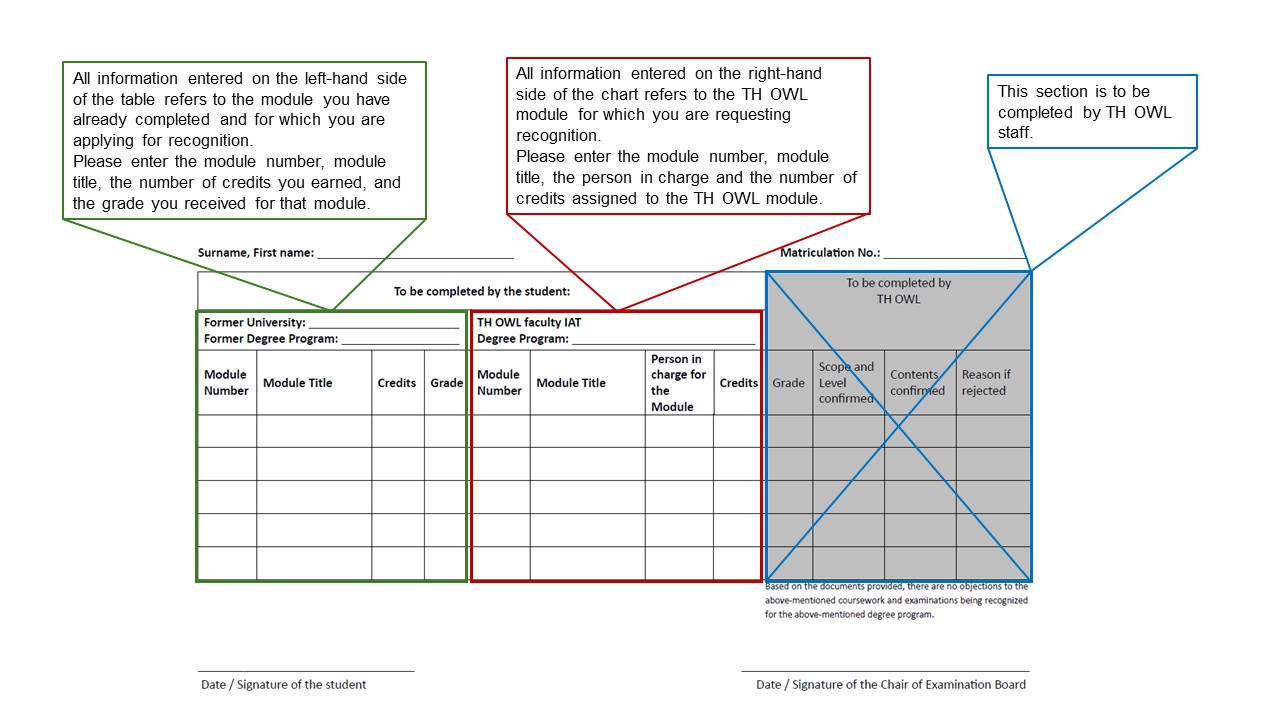
Yes, if you have already successfully completed modules that are part of your current degree program or cover comparable content, you can apply to have that coursework recognized.
To apply for recognition of examination results, you must submit the required application form and the accompanying sheet to the Examination Office, along with the module descriptions for the modules you have already completed and your transcript. If the module descriptions or the transcript are not in German or English, please include a certified translation.
If you have completed matriculation in the General Engineering degree program, please submit the application to your Coordination Office.
You can also find a diagram here showing how to fill out the application form.
Yes. You can take so-called NN modules, which are compulsory elective modules offered by your own University or another University. These may be recognized as substitutes for a compulsory elective module from your degree program’s regular module catalog, provided that the Examination Board approves the enrollment and recognition in advance.
If you wish to take an NN module, please inform your respective Examination Office well in advance of the module title, module number, the instructor in charge, and the faculty from which the module originates. In addition, before registering, you must confirm with the professor responsible for the module whether participation is possible based on available capacity. Only after the required approval has been granted can the module be recognized as a substitute for a compulsory elective module.
Practical Semester
The practical semester is a phase of the degree program during which students work at a company in their chosen industry. It is an integral part of the degree program and combines academic study with practical professional experience.
During the practical semester, students gain insight into professional fields within engineering and apply the knowledge they have acquired during their degree program in a practical setting. The goal is to gain practical experience and develop a better understanding of professional processes and requirements.
Yes, the practical semester is mandatory in the General Engineering degree program and must be completed in full before students can register for the required exams in the fifth semester.
Duration: 17 weeks in the fourth semester
Scope: Full-time, consisting of 4 days at the company and one day of intensive instruction in German III.2 or a company tour
Credits: Completion of the practical semester earns
25 ECTS credits
Prerequisites: The practical semester must be completed at a company in the industry corresponding to the chosen specialization and must be approved by the Examination Board
Students are responsible for finding their own internship placements. They are responsible for finding a suitable internship and applying in a timely manner.
We strongly recommend starting the search early, as application processes can take several weeks or months.
The faculty is happy to assist you in your search. Professorsand program coordinators are available to offer advice, for example, on questions regarding the academic suitability of a position or guidance through the application process. However, this support is contingent upon your actively seeking a placement and reaching out early if needed.
To earn ECTS credits, the 17 weeks of the practical semester must be completed in full and during a continuous period. Credit will be granted only if the internship site has been approved by the Examination Board before the start of the practical semester.
In addition to the practical work at the company, students must prepare an internship report. Furthermore, the experiences gained during the practical semester must be presented in a presentation.