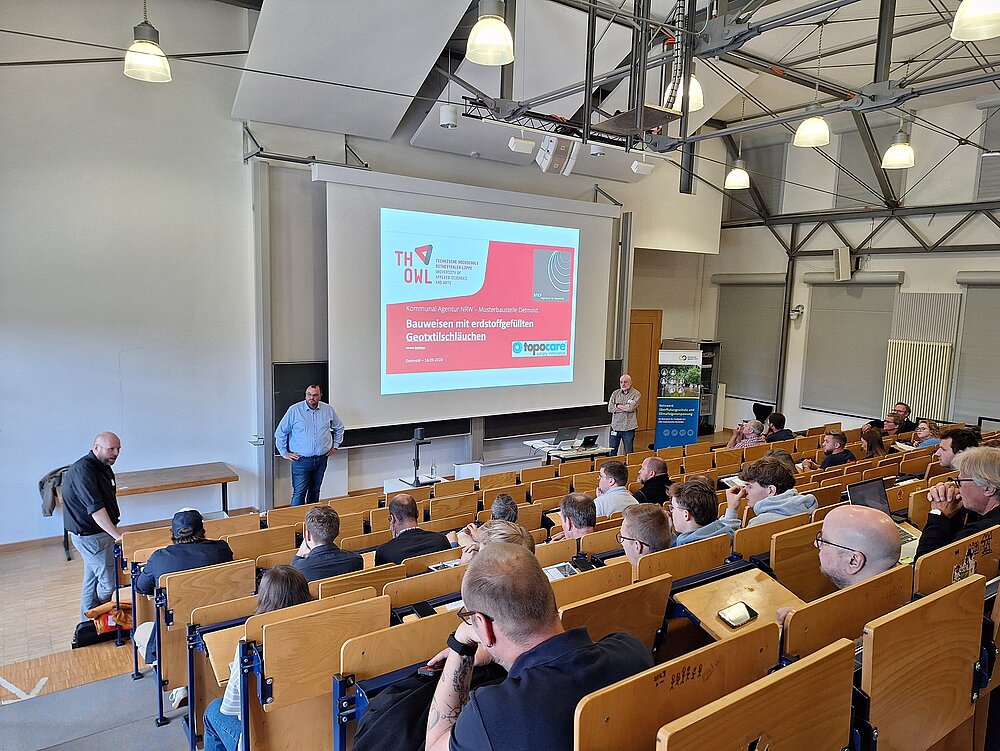
About 40 participants, primarily from municipalities and permitting agencies, learned about the City of Detmold’s heavy rain management plan, research conducted by the (TH) OWL University of Applied Sciences and Arts, and innovative construction methods developed by topocare GmbH.
The event brought together three perspectives: practical experience from local government, current research and development efforts, and technical implementation. The event was moderated by Marc Jansen from Kommunal Agentur NRW GmbH in Düsseldorf. Following the presentations, participants headed directly to the construction sites to see the measures and methods presented in action.-
Heavy Rain Management Plan as a Response to Extreme Events
The challenges that heavy rainfall poses for municipalities were clearly illustrated by the example of Detmold. On May 22, 2023, over 80 millimeters of rain fell within one hour. More than 100 buildings were severely affected. The Klüterbach stream, in particular, played a central role in this. Large volumes of water, mud, and chopped plant material from agricultural areas could not drain away quickly enough.
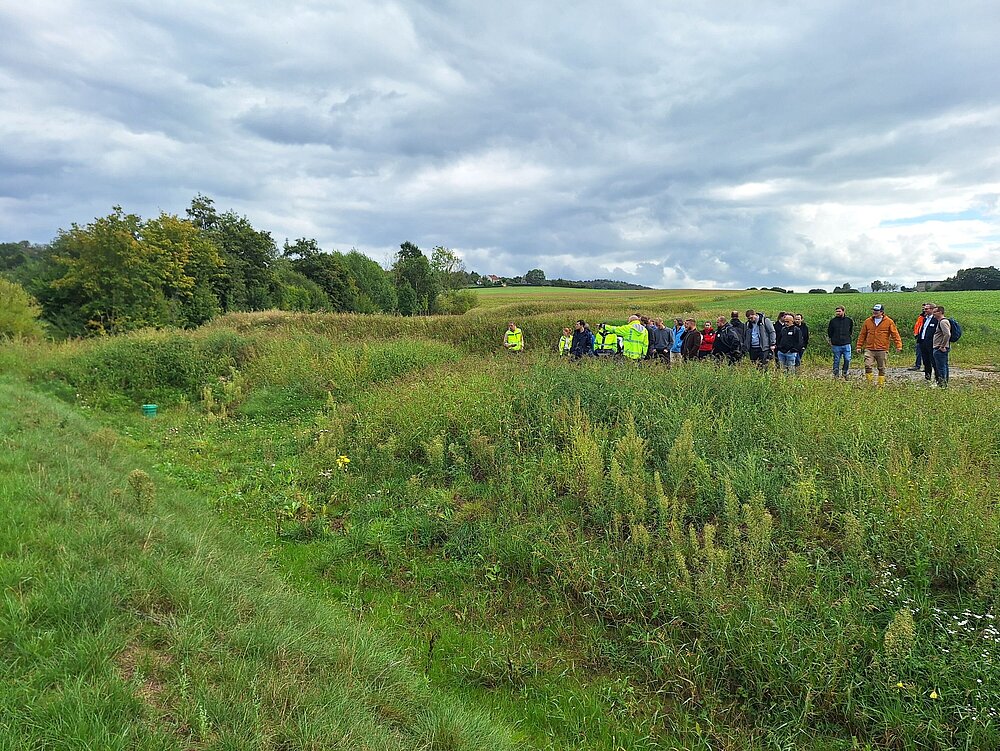
The city initially responded with emergency measures and, at the same time, developed a comprehensive heavy rainfall management plan. A key component of this plan is the trough-and-embankment system. These structures can retain water during heavy rainfall and slow down runoff. At the same time, they can be implemented relatively quickly, require little space, can be flooded, and can be operated with minimal maintenance and staffing. During smaller rainfall events, water is retained without the need for immediate cleaning of the canals or streets.
Andreas Hoffmann from the City of Detmold delivered the first technical presentation on the “Detmold Klüt Heavy Rain Management Plan.” He explained the city’s experiences and the development of the measures.
Subsequent heavy rainfall events put the concept to the test. One year later, two waves of rainfall occurred within a short period of time. The measures that had already been implemented proved effective. After the trough-and-embankment system was completed, another event in June 2025—with 90 to 120 millimeters of rainfall, according to the city—resulted in no damage.
Geotechnical Engineering: New Approaches with Geotextile Tubes
Carsten Schlötzer, professor of geotechnical engineering in the Faculty of Construction and Environment at TH OWL, then provided insights into research on soil-filled geotextile tubes. The method has been under further development at TH OWL for about twelve years. The principle is reminiscent of a large 3D printer: Endless geosynthetic tubes are filled on-site with soil material and shaped into stable structures. What makes this approach unique is the wide variety of materials that can be used. Many existing soils can be utilized to construct these structures, rather than having to be extensively reinforced—for example, by adding cement.
Potential applications range from water and dam construction to flood and coastal protection, as well as noise barriers, levee heightening, and bike paths on dams. The winding technique allows for the creation of steep, erosion-resistant, and overflow-proof structures with a small footprint. Sustainability aspects also play a role: the soil used is preserved as a resource, and the structures can be dismantled.
“Our goal is not only to research innovative solutions but also to work with municipalities and industry partners to bring them where they’re needed: to the construction site,” said Carsten Schlötzer, summarizing the event’s objective.
From Research to Technical Implementation
David Draier from topocare GmbH delivered the third technical presentation on “Machinery Technology.” He demonstrated how the construction method is transformed into a ready-to-use technology and introduced the technology behind the installation of geotextile tubes.
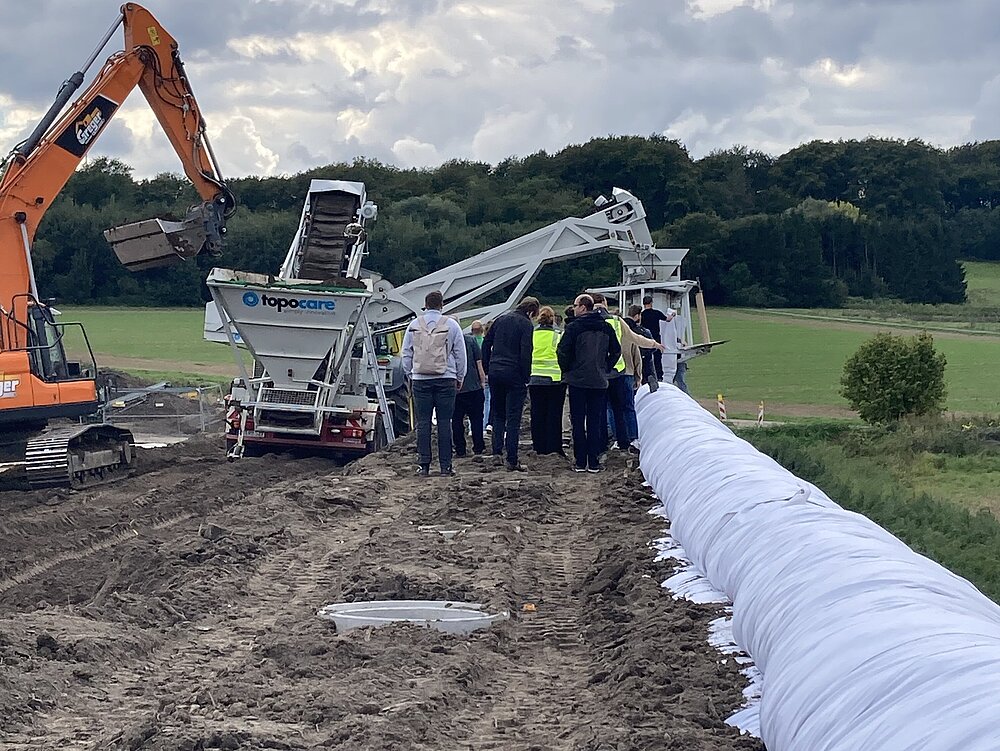
Two laying machines are used: The Topomover has enabled the continuous laying of geotextile tubes since 2012. The Topopacker operates semi-autonomously and is designed specifically for smaller areas.
The development of the processes and their technical implementation is carried out in collaboration with various partners, including RWTH Aachen University and the Faculty of Construction and Environment at TH OWL, specifically Professor Carsten Schlötzer’s Geotechnical Engineering section.
On-Site Practice
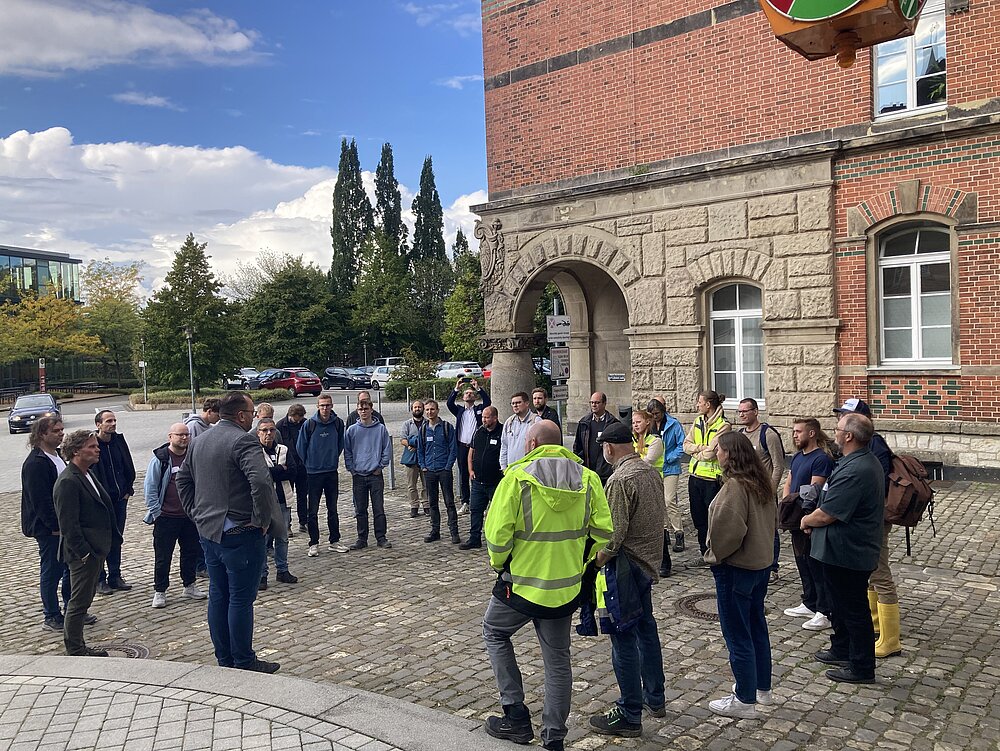
After the lunch break, the practical session began: The group traveled by bus to three construction sites and projects in Detmold. Among other things, they observed the tube-laying machine in action, the existing trough-wall system in Detmold-Klüt, and another project that complements the heavy rain management plan.
This direct insight into the implementation generated great interest and sparked many stimulating discussions. It clearly illustrated the journey from the municipal challenge through research and development to concrete implementation.
Developing Innovative Solutions Together
The “NRW Model Construction Site” demonstrated how collaboration between municipalities, research institutions, and companies can contribute to the development of new solutions for flood and heavy rain protection. The event made it clear: Innovative solutions emerge where research, municipal practice, and technical implementation come together.