“We want to create sustainable solutions that work in everyday life while making a measurable contribution to climate protection,” says Dirk Tappe, head of the Building Management Department.
One visible step is the introduction of waste sorting stations in the hallways. These have already been installed in Buildings 14, 16, and 5. The goal is to simplify waste separation while reducing the workload for cleaning staff. The concept was previously successfully tested and implemented in Building 4. Based on these positive results, the system will now be gradually expanded to other buildings on the Lemgo campus.
The university is also focusing on forward-looking solutions in the area of energy. Together with the BLB NRW, TH OWL is implementing photovoltaic projects on campus. In doing so, the university is taking a pioneering role and is among the first institutions to implement such a model in collaboration with the BLB. Two systems are scheduled to be installed this year on Buildings 14 and 16 in Lemgo.
What makes this model unique is that the university does not have to plan, tender, or pre-finance the systems itself. Refinancing is covered by the rent, which is paid for out of the savings in electricity costs. TH OWL uses the generated electricity for its own consumption. This is a decisive advantage, especially given the high energy demand. “We have a high base load in electricity consumption. By using the electricity ourselves, we can sustainably reduce our energy costs,” explains Tappe. In addition, the Building and Real Estate Management Department bears the risk in the event of potential installation errors.
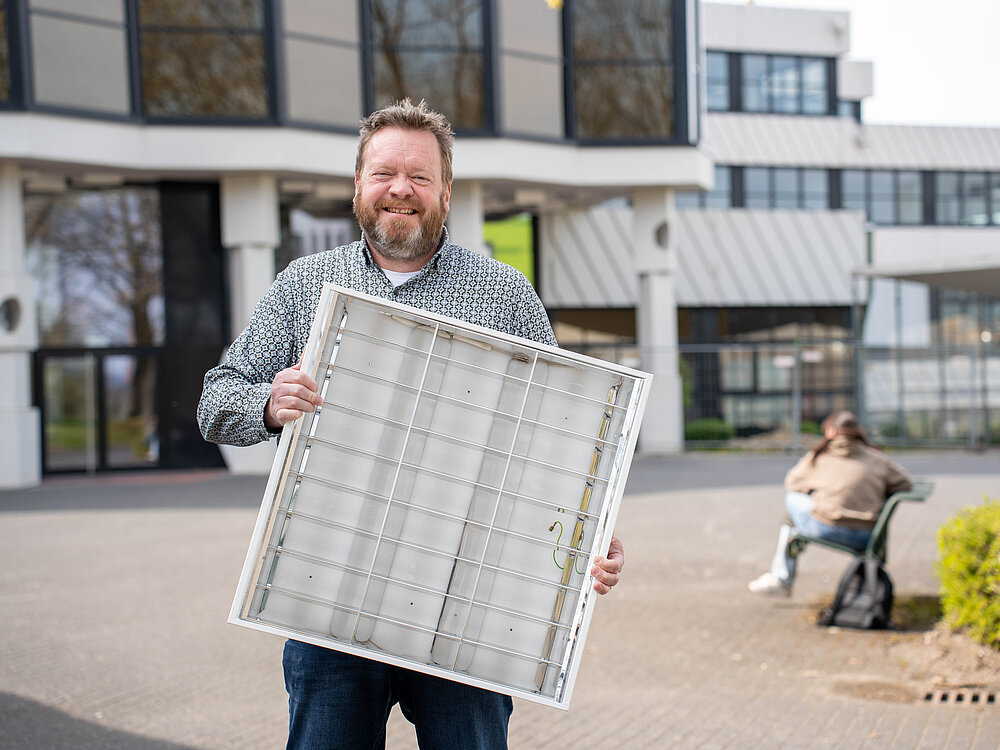
This initiative is complemented by additional energy-saving measures. The switch to LED lighting enables savings of up to 80 percent in lighting costs. At the same time, employees and students benefit from improved working and learning conditions, as the lighting can be individually adjusted.
Another key component is the expansion of energy monitoring. In the future, data on where and how much energy is consumed will be tracked even more precisely. The goal is to identify major energy consumers and leverage specific savings potential.
New opportunities are also emerging for research and teaching: At the Höxter campus, a modernized photovoltaic test facility is available, which is used not only for electricity generation but also in teaching. There, various scenarios related to energy generation and use can be tested in practice.
These measures directly contribute to the university’s climate goals. As part of the “Climate-Neutral State Administration” project, TH OWL aims to become climate-neutral by 2035. “The current changes are an important step on this path,” emphasizes Tappe.
In addition to energy and infrastructure projects, the further development of campus areas is also being actively shaped. Building 2 has now been completely demolished. Part of the vacated area is to be used as a temporary parking lot in the future. A project involving students from Höxter is planned for the remaining area. Together, they will develop concepts for sustainable and attractive use, such as through greening or sports facilities.
With these measures, TH OWL demonstrates how sustainable campus development can be implemented in practice—in a practical, efficient manner and through close collaboration between the university, public authorities, and students.