
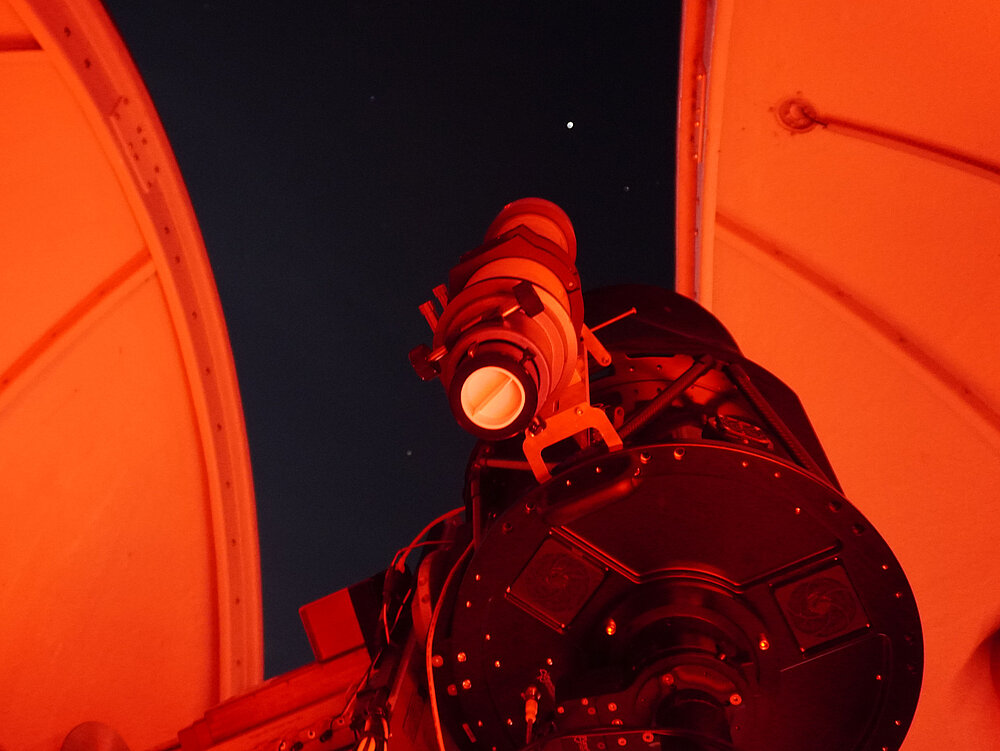
This program offered by TH OWL is open to anyone interested in the natural sciences and the exploration of the universe. No prior knowledge is required; however, a good sense of spatial awareness makes it easier to understand the material. Each lecture stands on its own, so it’s easy to join the series even at a later date.
Titled “New Horizons: From Returning to the Moon to the Mysteries of Our Solar System,” this year’s lecture series introduces some of the most exciting and current topics in modern astronomy. Each lecture focuses on a central topic—from the return to the Moon to the exploration of comets and asteroids, all the way to the latest findings on exoplanets and the evolution of our solar system.
The lectures always begin on Tuesdays at 5:30 p.m. in the Audimax of the (TH) OWL University of Applied Sciences and Arts on the Innovation Campus, Campusallee 12 in Lemgo. Registration is not required.
October 13: First Lecture – Return to the Moon
In the opening session, the observatory team will compare the historic Apollo missions with the modern Artemis missions. The audience will learn about plans for a potential lunar colony, what the orbital station might look like, and why the Moon serves as a stepping stone for future space missions.
October 27: Second Lecture – Comets and Asteroids
This lecture focuses on celestial mechanics and the orbits of comets and asteroids. Attendees will learn what distinguishes a comet from an asteroid, what danger they pose to Earth, and how they can be defended against.
November 10: Third Lecture – Europa: The Mysterious Moon of the Gas Giant
This lecture focuses on Jupiter’s moon Europa. Attendees will learn how subsurface oceans were discovered on Europa, what unique features this moon possesses, and how the exploration of these oceans might work. The lecture will also discuss the source of the energy that keeps the ocean liquid.
November 24: Fourth Lecture – Exoplanets and Their Atmospheres
This lecture is dedicated to the fascinating world of exoplanets. The audience will learn how the James Webb Space Telescope is used to study the atmospheres of exoplanets and what role spectroscopy plays in this process. The focus is on the composition of these atmospheres and the methods used to study them.
December 8: Fifth Lecture – Gravitational Waves
This lecture explains what gravitational waves are, how they are generated, and how they can be detected. Anyone interested will receive an overview of the signals recorded to date and a look ahead at future projects such as the Einstein Telescope.
December 22: Sixth Lecture – Deep-Space Exploration and Science Fiction
This Christmas lecture explores futuristic propulsion concepts that could make interstellar travel possible. Topics such as the “warp drive” and other hypothetical propulsion concepts will be discussed—an entertaining and exciting journey into the world of Star Trek and beyond.
January 12: Seventh Lecture – Astronomy at Home
This event shows guests how they can experience astronomy for themselves. They’ll learn how telescopes work, what’s visible in the night sky with the naked eye, and what makes for a dark sky location. In addition, Professor Üpping and his team will offer tips on what to look for when buying a telescope and what results to expect.
January 26: Eighth Lecture – News from the Solar System
This concluding lecture will focus on the evolution of our solar system. Here, participants will learn how Jupiter’s motion has shaped our solar system and why it looks the way we know it today. A comparison with classical theories of planetary system formation rounds out the series.
For more information and possible updates, visit:https://www.th-owl.de/sternwarte/