
Quality Management System
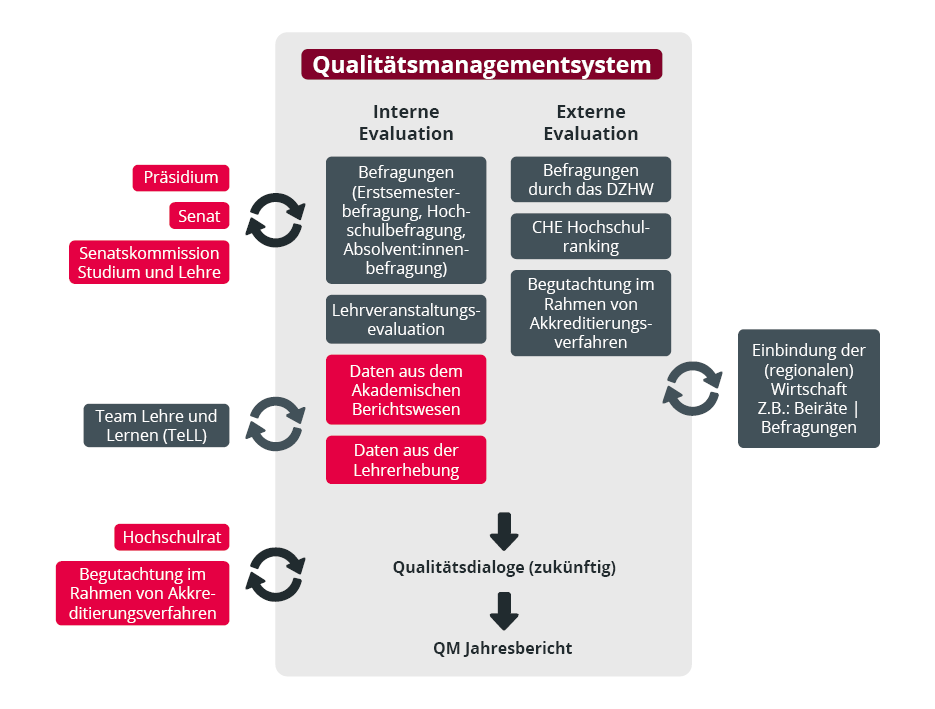
The quality of studies and teaching at TH OWL university of applied sciences and arts is continuously monitored. The formulation of objectives is fundamental to the understanding of quality, the achievement of which is checked, improvement measures formulated if necessary, implemented and their effectiveness checked again. This creates a control loop that serves to ensure and increase quality.
All activities are coordinated by the Department of Quality Management Studies and Teaching. It uses internal and external evaluation tools, prepares reports and further develops the quality management system through dialog.
Instruments of internal evaluation are internal university surveys in which first semester students, students from the second semester onwards and graduates are surveyed. In addition, a continuous course evaluation takes place. Another source of internal evaluation is statistical data provided by the strategic university development and digitization office as part of academic reporting and by various administrative units.
External evaluation instruments are surveys and evaluations for which the TH OWL is not responsible. These include the student survey in Germany, which is coordinated by the German Center for Higher Education Research and Science Studies (DZHW), as well as the CHE University Ranking, which is used nationwide to guide first-year students in their choice of degree program and university. In addition, the degree programs at TH OWL are regularly subjected to external accreditation. In this peer review process, an accreditation agency and experts with close professional ties assess the degree program concepts, make recommendations and, if necessary, impose conditions that TH OWL can or must implement.
The results of the internal and external evaluations are evaluated by the Quality Management Studies and Teaching department and checked for the achievement of the previously defined objectives using various indicators. The higher the degree of target achievement, the higher the quality. In a next step, these collected findings are discussed in regular quality dialogs with the individual departments. The aim of these discussions is to identify good practices and potential for improvement, from which measures can be derived to ensure or improve the quality of studies and teaching. Recording the quality dialogs ensures that the agreed measures and their effects can be reviewed at the next quality dialog.
The functionality of the quality management system is also evaluated by internal and external bodies. For example, the Quality Management Teaching and Studies receives valuable input every year when presenting the internal and external evaluation results to the Executive Board and Senate. In addition, the Standing Senate Commission on Teaching and Studies evaluates the effectiveness of the quality management instruments and the evaluation regulations on an annual basis. The University Council is involved in the external review, to which the evaluation results are also presented. In addition, the entire quality management system is examined by accreditation agencies, experts and stakeholders from the (regional) economy when accrediting degree programs.